Two numbers, two different tests
NVR and ionic extractables are the residue side of a wiper specification. Particle counts tell you what the cloth releases as solid matter; NVR and ionics tell you what it leaves behind when a solvent pulls chemistry out of the fiber. A cloth can pass a particle count and still fail a coating step, because the failure is a film, not a particle.
Both figures are usually quoted in milligrams per square metre, sometimes as ppm of the wipe mass. The units are not the problem. The method behind them is.
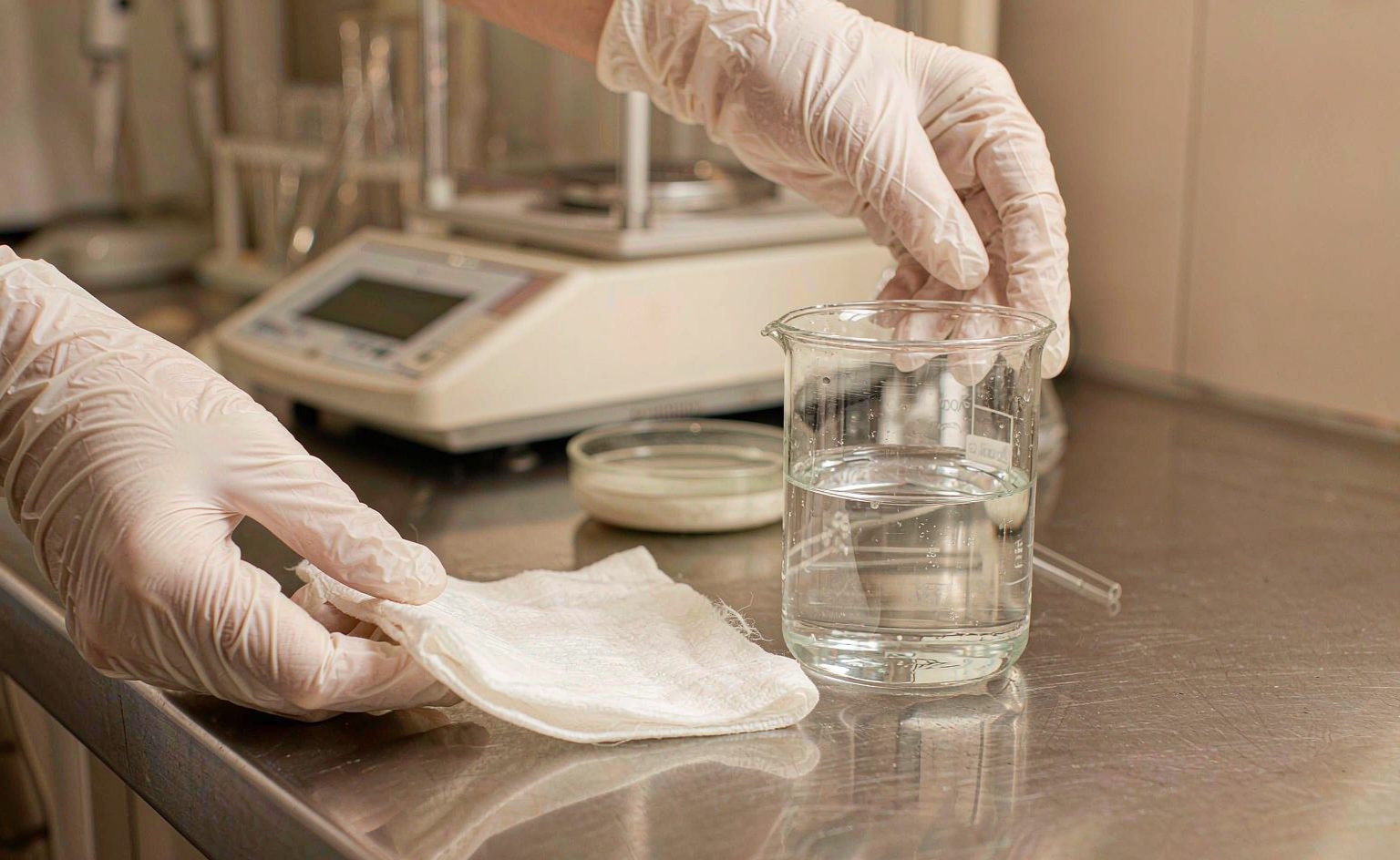
Non-volatile residue, step by step
NVR is what remains after a defined extraction and evaporation. The general sequence is consistent across laboratories, but the details decide whether two results can be compared.
- The wiper is extracted in a specified solvent — ultrapure water, isopropyl alcohol, or the solvent the customer actually uses.
- The extract is filtered to remove fiber and particulate.
- A measured volume is evaporated to dryness under controlled conditions.
- The residue is weighed on a microbalance and reported against the wiped area.
Change the solvent and you change the result. A water extraction on a polyester knit will not see the same chemistry as an IPA extraction on the same cloth. If a data sheet does not name the solvent, treat the number as indicative.
Ionic extractables: anions and cations
Ionic contamination is measured by ion chromatography and reported separately for anions (chloride, sulfate, nitrate, phosphate) and cations (sodium, potassium, calcium, magnesium, ammonium). For semiconductor and optics work these individual species matter more than the total, because chloride and sulfate attack metal lines while sodium migrates under bias.
Two rules of thumb hold across most critical applications: compare species by species, and compare the extraction method before comparing the totals. A low total that hides a high chloride figure is worse than a moderate total that is evenly distributed.
Where to set the limit
There is no universal NVR limit, and a supplier who quotes one without asking about your process is guessing. Work from the failure mode instead:
- Coating and bonding. A residue film changes surface energy. Ask for NVR in the solvent used in the process, and set the limit from a coating adhesion test, not from a catalogue.
- Semiconductor front-end. Set species-specific ionic limits and require lot-level data. The semiconductor application guide covers the surrounding protocol.
- Optics and displays. Residue shows up as haze or as a rainbow film under a coating. Water-extracted NVR plus a visual check at the intended viewing angle is usually more useful than a single threshold.
- General industrial cleaning. NVR is usually not the controlling property; absorbency and wet strength are. Do not over-specify a number the process cannot use.
Why two numbers never match
Different areas. One lab reports per wipe, another per square metre. A 30 × 30 cm wipe is 0.09 m²; the same residue expressed per wipe looks nine times smaller than a per-square-metre figure for a 0.01 m² sample.
Different evaporation. Residue that is baked at a higher temperature loses volatiles and reports lower. Ask for the evaporation conditions in writing.
Different handling. A wipe pulled from an open bag in a workshop picks up airborne residue before it ever reaches the extractor. Sampling in a cleanroom changes the result. The ISO class guide explains why the zone matters for handling, not just for the cloth.
What to ask for with the quote
Ask for the extraction solvent, the evaporation conditions, the reporting limit and the last four lot results for the specific grade you are buying — not for the family. Then ask which species are controlled and which are only monitored. A supplier who can separate the two understands the data they are sending.
If the residue question is close to your process limit, test before you buy: request samples and run them through your own extraction, or ask us to quote the data package for a specific grade.
Bottom line. Name the extraction solvent in the specification. For a critical surface ask for NVR measured in the solvent you actually use, plus species-specific ionics. A generic “low residue” claim is not a number you can reject against.
Frequently asked questions
Is NVR the same as particle release?
No. Particle release counts solid particles and fibers; NVR weighs dissolved and suspended residue left after evaporation. A cloth can be low in particles and high in NVR if the fiber contains extractable chemistry.
Should I specify NVR per wipe or per square metre?
Per square metre for comparison between formats, per wipe for a process calculation where the operator uses a fixed number of wipes. State which one is in the specification so the lab reports the same basis.
Does washing reduce NVR?
It reduces surface residue and loose fiber, which usually lowers both NVR and particle release. It does not remove extractables bound in the polymer. If the number has to be low, the fiber and the finishing route matter more than the wash count.
Does a higher GSM mean higher NVR?
Not by itself. GSM is mass per area; residue comes from finishing chemistry and fiber. A heavier cloth can report less NVR per square metre if it has been washed more thoroughly.
How should residue-sensitive wipes be stored?
Sealed, upright and out of sunlight. An open bag in a workshop collects airborne residue before the cloth ever reaches the extractor.