
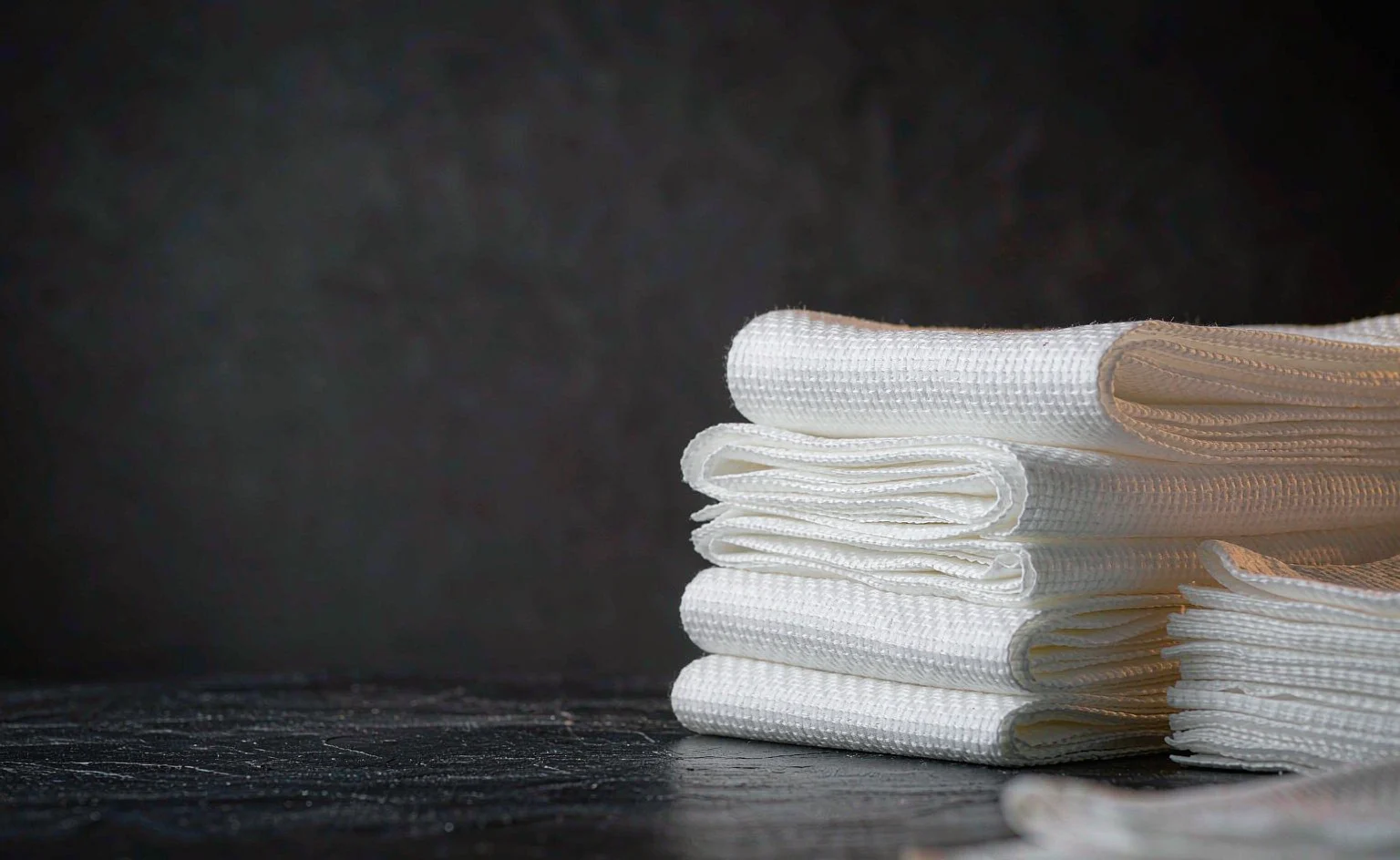
A wiping cloth is an engineered surface, not a generic rag. The fiber decides what the cloth absorbs, how fast it releases the soil, and how much of the cloth stays on the surface after the pass. The construction decides whether the cloth survives the solvent, the pressure and the number of passes the task actually needs.
Most wipe failures are material mismatches. A wood pulp cloth on acetone. A microfiber on a wax-heavy panel. A cut edge in an ISO Class 5 zone. The cloth looks white and clean, so the failure is invisible until the coating, the bond or the audit result shows up.
Why material beats GSM
GSM is a useful number, but it is not a material specification. A 140 GSM polyester knit and a 140 GSM wood pulp/polypropylene nonwoven can have the same weight and behave nothing alike. One is built for solvent resistance and low particle release; the other is built for fast, economical pickup of coolant and oil.
The blend ratio matters as much as the weight. A 55/45 cellulose/polyester spunlace balances absorbency with wet strength. A 80/20 polyester/nylon microfiber traps fine particles in the fiber. A 100% polypropylene meltblown is a different geometry again — high loft, high oil capacity, low wet strength unless it is laminated or supported.
Specify in this order: chemistry (what is being removed) → surface (what cannot be scratched) → cleanroom class (what cannot be left behind) → format and GSM. Price comes after the first four.
The six material families
Wood pulp / polypropylene
The X5–X8 universal cloths. Wood pulp gives fast absorbency and a soft hand; polypropylene adds wet strength and resistance to tearing. It is the economical choice for coolant, oil, dust and general bench work. Cut edge, flat sheet or roll, industrial through ISO Class 6–8 support areas. The X8 brag box adds a food-contact certification.
Cellulose / polyester
A spunlace blend that absorbs water-based soil quickly and holds together when wet. It is the general-purpose cleanroom and surface-prep construction: fast degreasing, good solvent resistance, lower cost than a polyester knit. Cut edge is common for ISO Class 6–8; a sealed edge is used where fiber release matters.
Polyester
Continuous-filament polyester knit is the workhorse of critical cleaning: low ion release, low NVR, low particle generation and good solvent compatibility. Double-knit and single-knit constructions differ in softness, absorbency and cost. Laser or ultrasonic sealed edges are standard for ISO Class 3–7. It is the correct tier for tool surfaces, optics and medical assembly, not for heavy grease.
Microfiber (polyester / nylon)
Ultrafine fibers create a dense web that traps particles inside and between the fibers instead of pushing them across the surface. The soft hand suits optics, displays, polished molds and precision assemblies. Microfiber is available as a knit, a nonwoven or a woven; the construction changes the abrasion resistance and the cost. It is not automatically the best choice for aggressive solvents or heavy oil.
Rayon / polyester and 100% rayon
Viscose rayon gives a soft, absorbent cloth with very low linting. The mesh constructions lift dust and fine particles from textured surfaces and are common in cleanroom support areas. Rayon is not the strongest fiber when wet; check the wet strength if the cloth will be used with pressure or on a rough surface.
Meltblown polypropylene
High-loft meltblown PP is an oil absorbent, not a general-purpose wipe. It absorbs many times its weight, can be washed and reused, and is available in cleanroom-grade versions where low lint matters. It is the right tool for sumps, spills and heavy oil; it is not a substitute for a sealed-edge wiper on a critical surface.
Material comparison
| Material | Absorbency | Solvent | Particle / fiber | Best use | Typical edge |
|---|---|---|---|---|---|
| Wood pulp / PP | High, fast | Moderate | Moderate | Coolant, oil, bench work | Cut |
| Cellulose / polyester | High | Good | Low–moderate | Degreasing, general cleanroom | Cut / sealed |
| Polyester knit | Moderate | Excellent | Very low | Critical tool and optics surfaces | Laser / ultrasonic |
| Microfiber | Moderate–high | Good | Very low | Particles, optics, displays | Sealed / cut |
| Rayon / polyester | High | Moderate | Low | Dust, mesh cleaning, support areas | Cut |
| Meltblown PP | Very high (oil) | Moderate | Moderate | Oil, ink, heavy spills | Cut |
What GSM and blend ratio tell you
GSM is weight per area. A heavier cloth generally holds more liquid and survives more passes, but it can also be slower to wet out and more expensive per square metre. A lighter cloth can be the right choice when the wipe is changed often and the soil load is light.
The blend ratio is the more useful number for chemistry. More cellulose usually means faster water absorption and lower cost; more polyester means better wet strength and solvent resistance; more nylon in a microfiber means a finer fiber and a softer hand. Ask for the ratio, not just the trade name.
Five questions before you specify
- What is being removed? Oil, water-based soil, wax, ink, adhesive, particles or a chemical residue.
- What is the surface? Coated panel, optical glass, anodized aluminum, stainless steel, a wafer tool or a food-contact belt.
- What cleanroom class? ISO 3–5 needs a sealed edge and lot data; ISO 6–8 can use a cut-edge cloth where the soil load is the main issue.
- What solvent? Water, IPA, acetone, MEK, toluene or a alkaline cleaner. Confirm compatibility before the trial.
- What format? Flat sheet, quarter-fold, interfold, brag box or perforated roll. The dispenser decides how often the cloth is touched and how much is wasted.
Frequently asked questions
Which wiping cloth material absorbs oil best?
Meltblown polypropylene has the highest oil capacity per gram because of its high-loft fiber structure. Wood pulp/polypropylene is the economical choice for coolant and light oil; cellulose/polyester is better for water-based soil and general degreasing.
Is microfiber always better than polyester?
No. Microfiber traps fine particles in the fiber and is softer on scratch-sensitive surfaces, but a continuous-filament polyester knit can have lower NVR and better solvent resistance for a critical tool surface. Match the construction to the soil and the audit requirement.
What does GSM mean on a wiping cloth?
Grams per square metre is the fabric weight. It drives absorbency, wet strength and hand feel, but it does not tell you the blend, the edge or the particle performance. Use GSM as one specification, not the specification.
Can a cut-edge cloth be used in a cleanroom?
Only in lower-class support areas where the particle risk is controlled. For ISO Class 3–6 critical surfaces, use a laser, ultrasonic or heat-sealed edge and ask for lot particle data.
Next step
Put two materials on the same surface.
Tell us the soil, the substrate and the cleanroom class. We will send two candidate cloths and the test data to compare them.
Request a sample
