
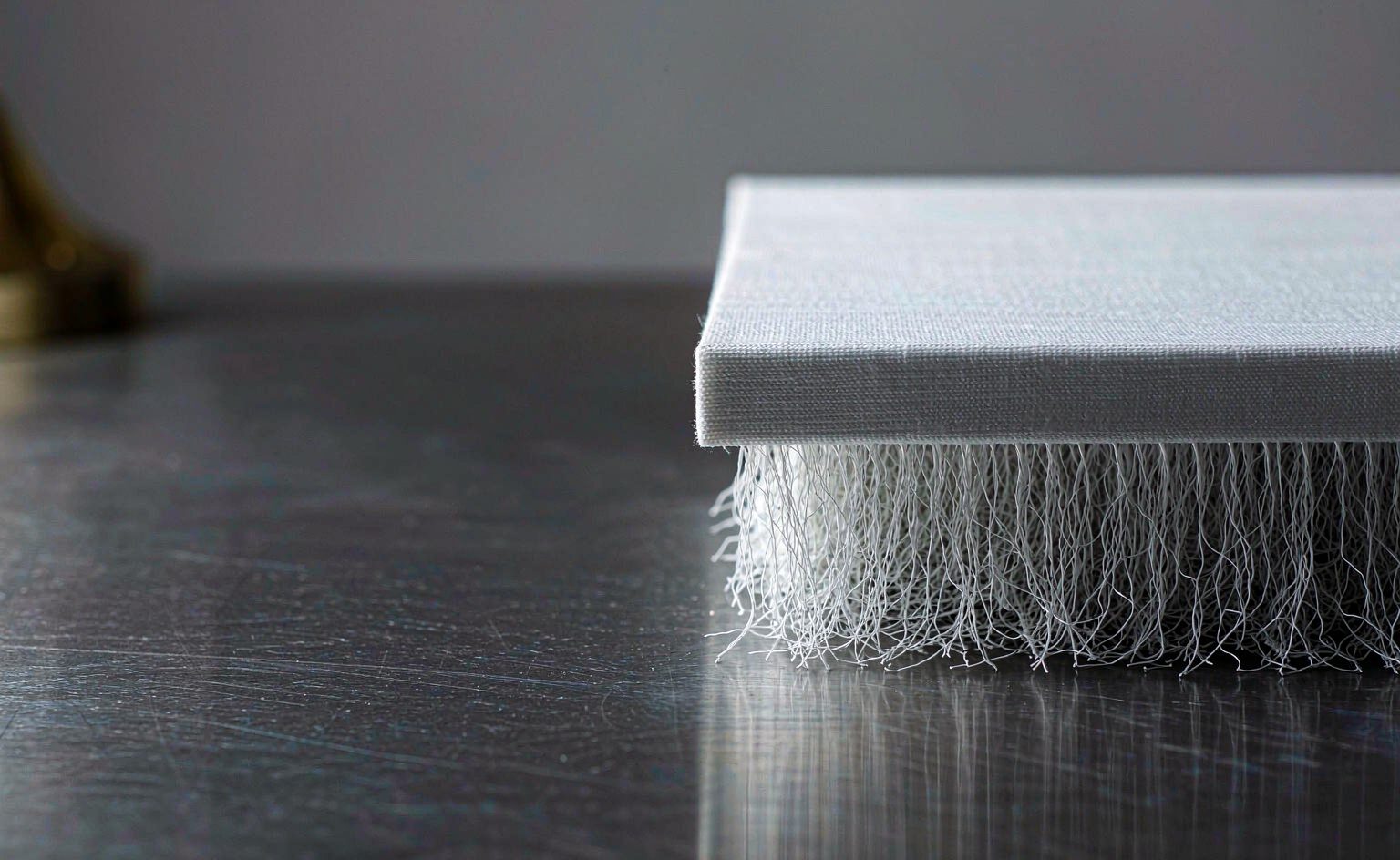
Every wiping cloth has an edge, and every edge is a compromise between cost, hand feel and fiber release. The cut edge is the cheapest and the most likely to shed. The sealed edge costs more and gives the cleanroom the control it needs. The choice is not a matter of premium positioning; it is a matter of what the surface can tolerate.
Edge quality is also a converting issue. A laser seal that is too hot becomes brittle; an ultrasonic seal that is too light leaves a loose fiber line. The edge has to be inspected, not just specified.
What an edge actually does
The edge is the boundary between the cloth and the room. In a cut-edge cloth, the fibers at the cut line are free to migrate during the wipe. In a sealed-edge cloth, the fibers are melted or bonded together at the border, so the cloth releases less from the edge and holds its shape under pressure.
Sealing does not make a poor fabric good. A sealed edge on a low-quality nonwoven still sheds from the face. The edge is one control in a chain that includes the fiber, the binder, the converting room and the bagging.
The four edge types
Cut edge
Mechanical cutting with no seal. Lowest cost, softest hand, suitable for industrial wipe-down and ISO Class 7–8 support areas. It releases fibers from the cut line and is not the right choice for a critical surface or a solvent-heavy wipe.
Laser-sealed edge
A focused laser melts the fiber ends into a narrow bead. Low particle release, a clean border and good dimensional stability. Common on polyester and microfiber for ISO Class 3–6. The bead can feel slightly stiff; check the hand feel if the operator uses the cloth on a soft surface.
Ultrasonic-sealed edge
High-frequency mechanical energy bonds the fibers without a melted bead. Available in wide and narrow borders. Soft hand, low fiber release and good drape; common on microfiber and polyester for critical surfaces. The tooling and the border width matter — a narrow border gives more usable cloth, a wide border is more robust.
Heat-sealed edge
A heated die seals the border. Lower cost than laser or ultrasonic, with a slightly thicker edge and good fiber control. Suitable for ISO Class 6–8 and for cloths that need a defined border without the cost of a laser line.
Edge comparison
| Edge | Process | Fiber release | Typical class | Cost | Notes |
|---|---|---|---|---|---|
| Cut | Mechanical cut | Highest | ISO 7–8 / industrial | Lowest | Soft, economical, not for critical surfaces |
| Laser | Melted border | Very low | ISO 3–6 | Higher | Narrow bead, good stability |
| Ultrasonic (narrow) | Mechanical bond | Very low | ISO 3–6 | Higher | Soft hand, more usable area |
| Ultrasonic (wide) | Mechanical bond | Very low | ISO 4–7 | Higher | Robust border, good for heavy use |
| Heat-sealed | Heated die | Low | ISO 6–8 | Moderate | Thicker edge, cost-effective |
How to inspect an edge
- Visual: look for a uniform border, a loose fiber line, a discolored bead or a wrinkle. A bright light and a dark background help.
- Tape test: press a piece of tape across the edge, lift it and inspect the fiber transfer. Compare with the lot report.
- Wipe test: wipe a dark, clean panel with the cloth and inspect under raking light. The edge should not leave a fiber trail.
- Lot data: ask for LPC and fiber-release results. If the supplier cannot provide them, the edge is a claim, not a specification.
Which edge for which surface
- Wafer tools, optics, isolators: laser or ultrasonic sealed, low-NVR microfiber or polyester.
- Paint prep and general cleanroom: cut edge for the first pass, sealed edge for the finish pass if the coating is sensitive.
- Industrial wipe-down, coolant, oil: cut edge is usually sufficient; the soil load is the main issue.
- Food-contact and general maintenance: cut edge with a controlled disposal program; the edge is not the primary risk.
Frequently asked questions
Is a laser-sealed edge better than ultrasonic?
Both lock the fibers in. Laser sealing gives a narrow, melted edge and is common on polyester and microfiber; ultrasonic sealing uses mechanical energy and can produce a wider, softer border. The better choice depends on the surface, the class and the hand feel the operator needs.
Can I use a cut-edge wipe in ISO Class 6?
It is possible in some support areas, but it is not the default. For a critical surface in ISO Class 6, use a sealed edge and ask for lot particle data. The cut edge is the first place a fiber will release.
Does a sealed edge reduce absorbency?
The sealed border is a small fraction of the cloth and does not change the absorbency of the center. A very wide seal can reduce the usable area slightly; the trade-off is fiber control.
How do I check an edge in receiving?
Look for a uniform border, a loose fiber line or a melted bead. Run a tape test on a sample and compare the fiber release with the lot report. A visual check alone will miss a weak seal.
Next step
Look at the edge under a light.
We will send two edge constructions on the same fabric so your team can compare the hand feel and the fiber release.
Request an edge sample
