The wipe looked clean. That was the problem.
A technician wipes a stainless panel with a folded polyester wipe, turns it once, wipes the same area again. By the third pass the cloth is no longer removing soil — it is redistributing it, a thinner film each time, until the panel looks acceptable under the light and fails the tape test an hour later. Nobody in that sequence did anything careless. The wipe simply ran out of clean face before the job ran out of surface.
Most specifications describe the wipe, not the motion
Open a wiper specification and you will find a size, a weight, an edge, a class and a test method (the class definitions are worth reading once). What you will not find is how many passes the wipe is expected to make, how it is folded between them, or at what point it goes into the waste bag. Those three decisions are left to whoever is closest to the panel, usually under time pressure, usually without a number to hit.
That is where a technically correct product turns into a variable process. Two operators can use the same carton and produce two different cleanliness levels, and neither of them is wrong according to the document.
What comes back on the second pass
A wipe in use carries three things: soil, liquid and particles. On the second pass, the loaded face puts a fraction of all three back onto the surface. The fraction depends on pressure, how volatile the solvent is, and how saturated the cloth already is.
The counter-intuitive case is the dry wipe on a dry surface. With no liquid film to hold soil in suspension, contamination moves as dust: it is lifted, carried a few centimetres and dropped. The panel can look better and measure worse.
A pre-wetted wipe behaves differently. The solvent film holds particles in the cloth instead of pushing them across the surface, which is why a slightly wet wipe usually outperforms a dry one on particle removal — and why the same wipe can underperform on a water-sensitive coating.
Count faces, not passes
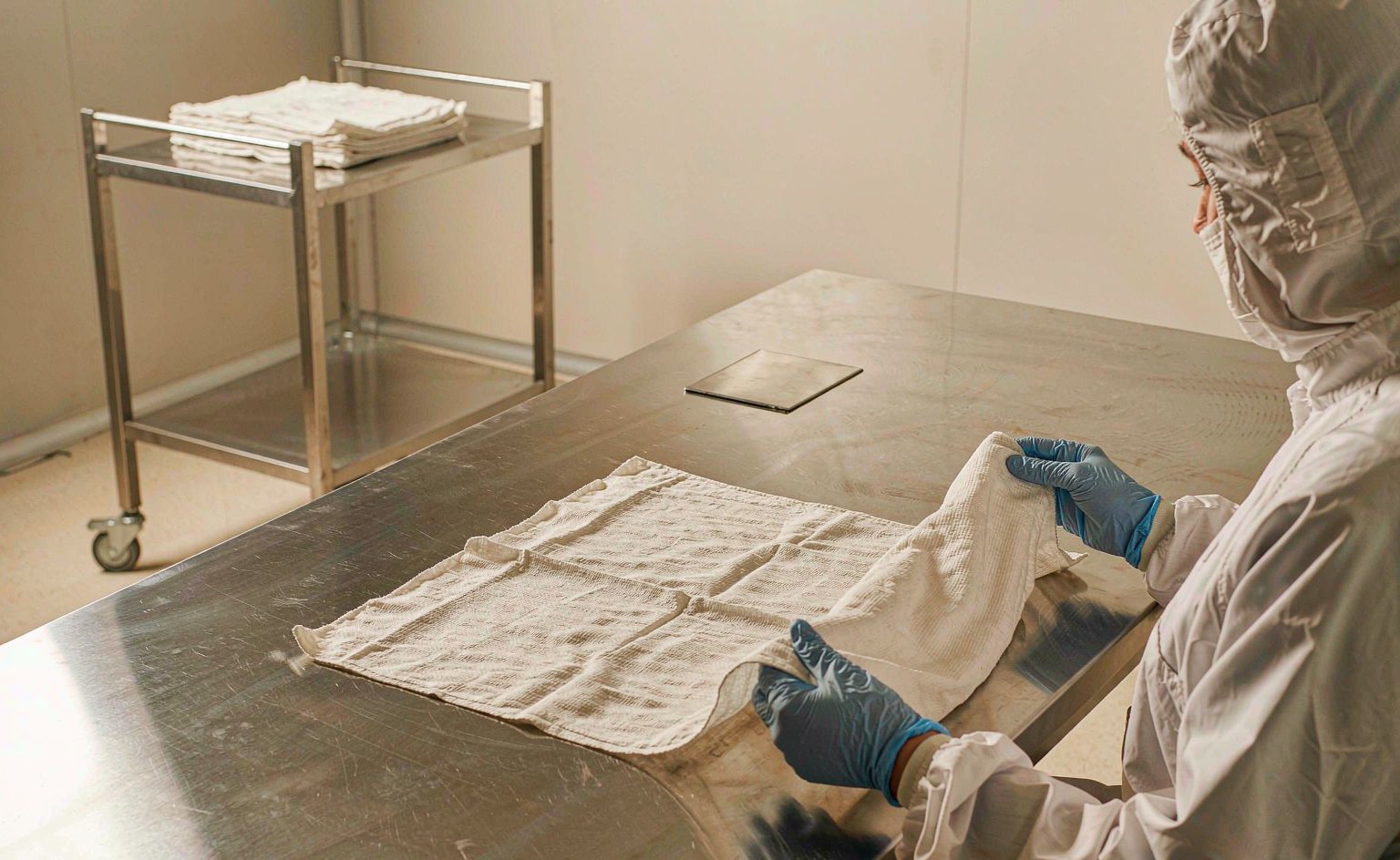
The number of clean surfaces on a wipe is arithmetic, not opinion. A quad-fold gives four layers; every layer has two sides; eight faces. In practice, two of those faces have been handled by a glove, so six are usable for cleaning and the last two are the ones you hold.
| Format | Fold | Faces | Usable clean faces | Realistic passes |
|---|---|---|---|---|
| 9 × 9 in | Quad | 8 | 6 | 6–8 |
| 12 × 12 in | Quad | 8 | 6 | 6–8 |
| 4 × 4 in | Single fold | 4 | 3 | 3–4 |
| Perforated roll | None | 2 | 1–2 | 1 |
The interesting column is the last one, because it is the only one a line supervisor can enforce. “Use a wipe until it is dirty” is not instruction. “Six faces, then a new wipe” is.
A bigger wipe is not automatically more wipe
Moving from 9 × 9 to 12 × 12 increases the area you cover per pass. It does not increase the number of faces. If the larger wipe costs more per unit and gives the same six clean faces, the cost per clean face goes up by roughly the same percentage as the price — unless the larger sheet replaces two smaller ones on the same panel.
The arithmetic is worth writing down once:
Cost per clean face = price per wipe ÷ usable faces.
Run that on two quotes and the “cheaper” carton often stops being cheaper. The same formula explains why a heavier wipe can be the economical one in a solvent application — the material guide covers which constructions hold solvent longest: it holds more liquid, so it keeps cleaning after a lighter cloth has gone dry and started pushing soil around.
The solvent trap
There is a second pass problem that has nothing to do with the cloth. A wipe loaded with soil is dipped back into the solvent bottle or tray, and the bottle becomes a suspension of everything the line has removed that shift. From then on, every “clean” wipe starts with contamination built in.
The fix is boring and effective: a squeeze bottle instead of a dip tray, one wetting per wipe, and a defined point where the wipe is discarded rather than re-wetted. If the process needs a tray, the tray needs a change interval written next to it.
What to put in the specification
Five lines turn wiping technique into something auditable:
- Passes per wipe — stated as clean faces, not “uses”.
- Fold discipline — how the wipe is folded, and that a used face never returns to the surface.
- Wetting method — squeeze bottle or tray, with a change interval if a tray is used.
- Discard point — visible soil, dry edge, or a fixed number of faces, whichever comes first.
- Verification — who checks it, how often, and what evidence is kept.
None of this requires a new product. On the lines where we see the largest improvement, the wipe did not change at all — the count did.
If you are choosing the wipe as well as the method, the cleanroom wiper range lists the sealed-edge formats by class, and the FAQ covers what buyers ask before the first sample.
How many times can a wiper be reused?
Count faces, not uses. A quad-folded wipe has six usable faces after the two handled faces are excluded, so six passes is the realistic ceiling on a clean surface. On heavy soil it is fewer, because saturation arrives before the faces run out.
Does folding really change the result?
Yes, for two reasons. It doubles the usable area without adding material, and it keeps the loaded face away from the surface on the next pass. An unfolded wipe is a single face used repeatedly, which is the definition of smearing.
Should wipes be pre-wetted?
For particle removal, usually yes: the liquid film holds soil in the cloth. For dry soil on a water-sensitive coating, or for a surface that must be dry before the next step, a dry wipe with a folded, frequently changed face is the better choice. Match the method to the soil, not to habit.