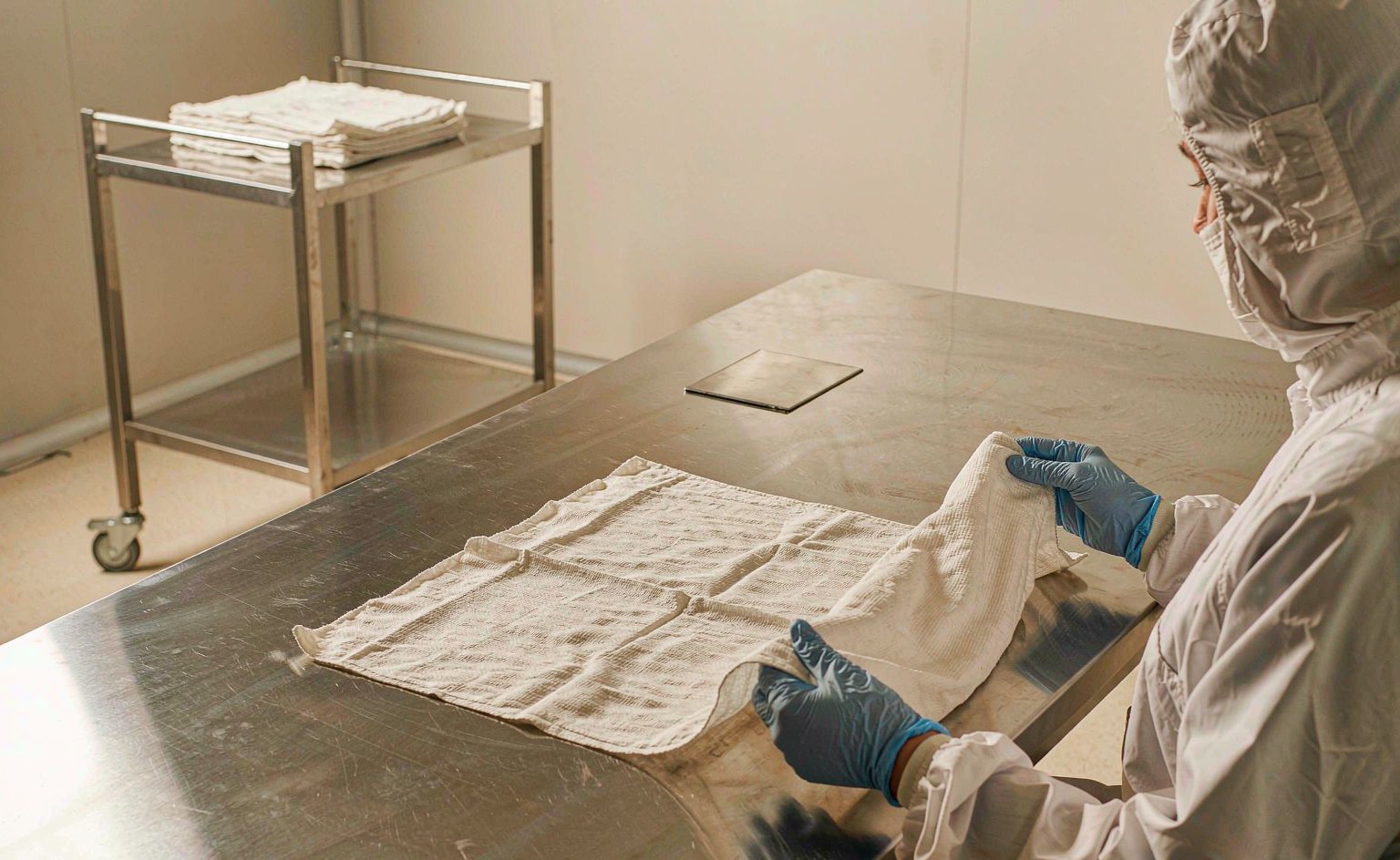
The bag was at the back of the shelf, behind two newer lots. The label had a production date and no expiry date, which is common enough. The line needed wipers that afternoon. Someone cut it open.
That decision is made thousands of times a year in cleanrooms, and it is almost never written down. A wiper is not food — it does not rot — but “it does not go off” and “it is still fit for a Grade B surface” are two different claims. The gap between them is what a shelf-life specification is for.
A wiper has three clocks, not one
When a supplier quotes a shelf life, ask which clock they mean. They run at different speeds and expire independently.
- The material clock. Polyester, polypropylene and cellulose blends do not decompose in a warehouse. What changes is the surface chemistry: spin finishes, antistatic agents and surfactants migrate slowly to the fibre surface, and the wipe that was low-residue at month one is not identical at year four.
- The packaging clock. Film embrittles, seams creep, and a bag that held a vacuum at dispatch slowly takes on air. Once the barrier is gone, the wipe is exposed to whatever the storeroom holds — humidity, cardboard dust, diesel from a forklift.
- The sterility clock. For gamma-irradiated product, the expiry date is not a material property at all. It is the end of the period for which the sterility assurance level was validated in that specific packaging. Change the film and the clock resets; change nothing and it still runs out.
Typical ranges, and what drives them
The numbers below are industry-typical for sealed, unopened product stored under the conditions in the next section. They are not a substitute for the lot certificate — the point is to know which question to ask when a supplier quotes a single figure.
| Product | Typical shelf life | What limits it | Worth re-testing |
|---|---|---|---|
| Dry cleanroom wiper, non-sterile | 2–5 years | Spin finish migration, bag seal | NVR, LPC, absorbency |
| Pre-wetted wiper (IPA or solvent) | 1–2 years | Solvent loss through the film, ratio drift | Solvent ratio, residue |
| Gamma-sterilised wiper | 2–3 years | Validated SAL period for that packaging | Sterility, seal integrity |
| Cellulose / wood-pulp wiper | 2–3 years | Moisture uptake, yellowing | Absorbency, extractables |
| Perforated roll, open format | 1–2 years | Exposed edges, dust ingress | LPC |
Two of those rows deserve a note. Pre-wetted product is the one where the label date is genuinely a hard limit: the alcohol does not disappear, it redistributes, and the top of the stack ends up drier than the bottom. Sterile product is the one where the date belongs to the packaging as much as to the cloth — a sterility assurance letter that names the wipe but not the film is incomplete.
Storage: four conditions that matter, two that do not
Temperature and humidity. 15–25 °C and below 60% RH covers most specifications. Above that, cellulose takes up moisture and nonwovens start to feel limp; the wipe still works, but the absorbency figure on the data sheet no longer describes it.
Light. Ultraviolet is the quiet one. A pallet stored beside a loading door for a summer does more damage to the film than a year on a dark shelf.
Compression. Stacking heavy cartons on wiper cases creases the folds. A crease is an abrasion point, and an abrasion point sheds fibre — the exact failure the product was bought to avoid.
Chemical neighbours. Solvent drums and cleaning chemicals outgas. A sealed bag is not a sealed barrier against a vapour gradient over eighteen months.
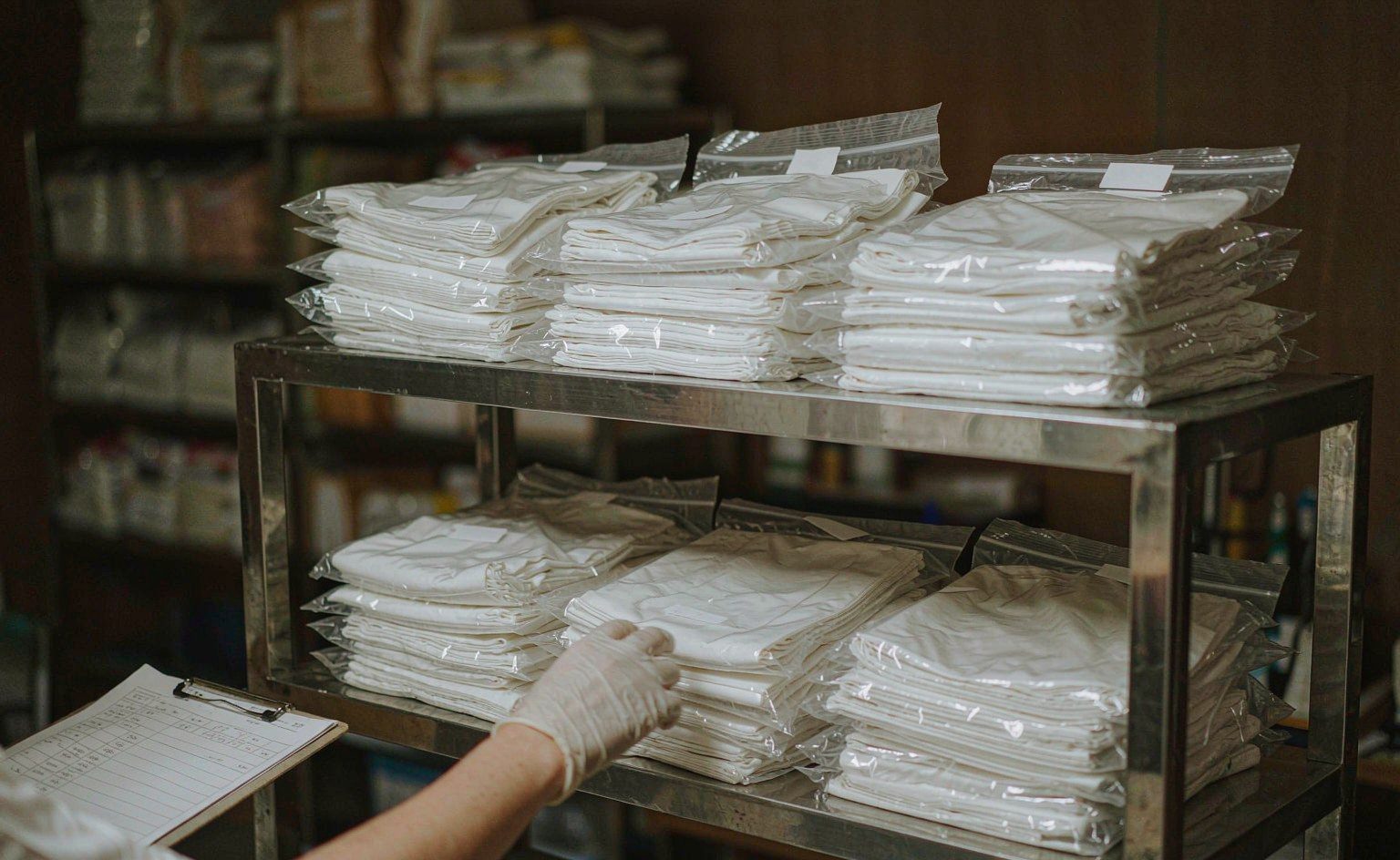
What does not matter as much as people think: the direction the pallet faces, or whether the carton is opened on a Monday. What matters is whether the bag is closed between uses and whether anyone has written the opening date on it. That single line of marker pen does more for cleanliness than most storage SOPs.
Re-testing beats guessing
If a lot is past its date but the packaging is intact and the storage was controlled, there is a defensible route: quarantine it, sample it, and re-test the properties that matter for the intended use. For a non-sterile cleanroom wiper that usually means three things.
- Liquid particle count (LPC) — the fastest signal that the material has started to shed.
- Non-volatile residue (NVR) — catches finish migration that particle counts miss.
- Absorbency and mass — a simple gravimetric check that reveals moisture uptake or solvent loss.
For sterile product, add sterility and seal strength, and treat a failure as final. There is no accepted practice of re-sterilising a wiper that has already been irradiated and stored; the dose history and the packaging validation no longer describe the item in your hand.
If re-testing is not available, the fallback is a downgrade, not a waiver: the lot moves to a non-critical application — workshop benches, machine exteriors — where particle and residue limits are not the controlling property. What should never happen is the third option, which is using it in the critical zone and hoping.
What to write into the specification
- Shelf life, stated per format — dry, pre-wetted and sterile are three different numbers.
- The reference packaging — film structure and layer count, because the date depends on them.
- Storage conditions — temperature, humidity, light, and the rule on compression.
- Opened-bag rule — where it may be opened, how it is resealed, and how long it may stay in the zone.
- Disposition — who authorises re-test, who authorises downgrade, and what evidence is kept.
None of this is expensive. It is the difference between a date on a bag and a decision someone can defend six months later.
The short version
Wipers do not expire the way food expires, and that is precisely why the date gets ignored. Treat shelf life as three separate clocks, store the pack the way the film was qualified, write the opening date on the bag, and re-test before you promote an old lot back into a critical zone. If you are choosing the packaging at the same time, the packaging note covers film, layers and transfer sequence; the cleanroom range lists which formats ship vacuum-sealed by default.
Do cleanroom wipers actually expire?
The cloth does not rot, but the pack does. Film embrittles, seams creep, and surface finishes migrate. A 2019 lot in an intact bag is usually fine for a workshop bench; whether it is fine for a Grade B surface depends on re-testing, not on the calendar alone.
How should an opened bag be stored?
Resealed, off the floor, away from solvent drums and daylight, with the opening date written on the bag. A common rule is one shift for an opened inner bag in a critical zone, replaced at the next shift. Pick a number and write it down — a rule in someone's head is not a control.
Does gamma irradiation shorten shelf life?
It changes what the date means. Irradiation can embrittle some films and affect seal strength, so the validated sterility period is tied to that film and that dose. If the packaging changes, the sterility clock has to be re-established even though the wipe is identical.